
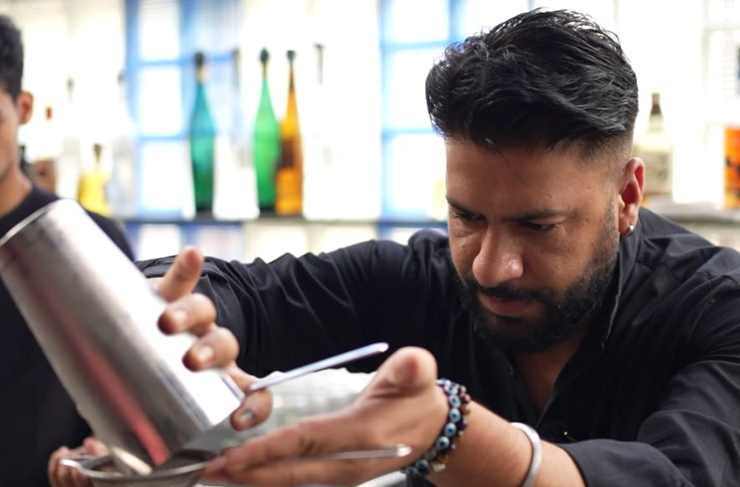
403 Forbidden is the message a server returns when you're not allowed in: Access Denied. Aman Dua has turned that small digital refusal into a philosophy you can sit inside. Walk into his Bangalore bar and the world's feeds fall away — there is light, a drink in your hand, and the people in front of you. In conversation with Jigar Ganatra, Managing Editor of Burp Bible, Aman Dua — Mixologist at 403 Forbidden — shares his bar, city, and craft.
"403 Forbidden" is such a distinctive name, and there's clearly a whole philosophy sitting behind it. Where did it come from?
It started with a vision. "403 Forbidden" is a digital error code — it means "Access Denied" — and that's the whole idea: access denied from the digital world. We don't encourage people scrolling their Instagram feeds in here and the real point of the room is to make memories — the kind people carry home with them. When you're sitting in the car on the way back, you should still be talking about this place. And it shows in everything we do, one to one: the food, the drinks, and of course the hospitality.
And do you find it actually works — that people genuinely set the phone down once they're inside?
So far, I'd say we've done really well in telling people that story. When you build a room like this, within a couple of years people merge with it; they pick up on what it's about and they simply stop reaching for their phones. They don't need it anymore. Some are still distracted now and then, and that's completely fine — it's part of it. You're not forcing anything on anyone; the space does the work.

Your Instagram handle has a wonderful ring to it — "beverage programmer." So who is the Aman standing behind the bar?
On Instagram, my bio still says "beverage programmer." I have no connection to software or IT, but that's a name I've carried since 2014. The journey since has been a real rollercoaster. What I love is making drinks and I think I'm one of those lucky people who genuinely love their work, make a living from it, and are happy doing it — so I'm grateful to be in this profession. Serving people is something I'm proud of. They light up when they drink, when they eat, and they leave you a little note about it. That note is the reward. That's the whole job.
Two decades in, and clearly still in love with it. What keeps you going — and if you had to put it simply, who is Aman?
Honestly, I wouldn't know what else to do. Once you've learned something over twenty years, it's too hard to unlearn — if you asked me whether I could do something else, I don't think I could. This is in my blood now; I live this life and I'm happy in it. People know me as all sorts of things — a good friend to one person, a mentor to another, a serious or inspiring figure to someone else. Everyone has their own story of me, and that's a lovely part. But if I had to define myself, it's simple: a happy man, grateful for everything that's happened to him.
That gratitude seems bound up with this city. What is it about Bangalore that holds you the way it does?
The name plays on what Bangalore is — the IT city. But the city claimed me the moment I walked out of the airport in 2016; there was just something here. I think I manifested it, that one day I'd be sitting here with my family — and by 2018 it had happened. The people, the culture, the sheer versatility of it. Running a bar gives you the chance to meet all of it, and I've made a lot of friends along the way. People come out at the end of a long week not to plan their next move but to switch off — and if you can build a space that gives them that, you've done your job. Bangalore rewards effort in kind: you give it to them, and they give it right back.
You've watched its bar scene grow up around you. How has Bangalore changed in that sense and in that time?
Every time, it surprises me — that's the best part. I can say it's a cocktail capital. When I opened a place, it was meant to come with a brewery; that didn't happen at first, and the brewery only opened later. I still remember the appreciation we got back then, standing behind the bar making drinks for people — even the non-alcoholic ones. People see your effort and they love you for it. In 2016 the appetite for innovation was maybe four out of ten; today it's a ten, and people lean in to ask, what's next? Other big cities grow at its own pace and have always been different, but here a small space can become a famous bar and actually make money. That's Bangalore.
That appetite for the new shows in your takeover nights, which have become a signature. What excites you about them — and who would you most love behind the bar with you?
Honestly, I don't even like the word "takeover" — it's a collaboration. You bring a new talent behind the bar, someone with real years in them, and your regulars walk in to find something fresh happening; the energy lifts, everyone's happy, and the moment they leave smiling, I'm done. I won't crown a favourite — they each bring something - very serious and precise and I always learn a great deal just watching how they operate. My efforts are only to ensure that the calendar keeps filling with collaborations and it's all learning. None of it feels like pressure, either; it's an opportunity, a chance to showcase yourself with the whole fraternity watching. A real challenge is something you force yourself to do, and this isn't that. The only challenge I set myself is to become a better person, not a better mixologist — get the first right and the second takes care of itself. If I could choose anyone to stand beside me, it would be my mentors and those who’ve built something with extraordinary energy.
You've built something people clearly love. When you look ahead, where do you see 403 going — and what are you reaching for next?
I'm honestly not thinking about expansion, but for now, this city has all of my attention. I want to serve Bangalore first, and I'm not done with it yet. And I don't keep a wish list. I just try to be a little better every day, learn from my mistakes, and not repeat them — no lookbacks, just a little better than the day before. The success, the name and the fame — that's all a by-product. You can't chase it; it comes to you. I live by the day and if that feeling stays with me when I go to bed, I'm good.