
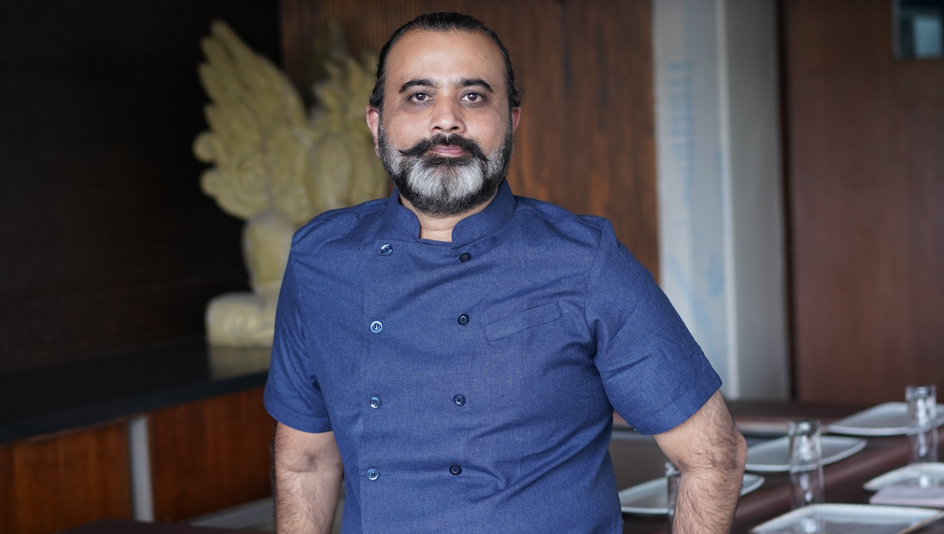
Some restaurants chase the moment; Shiro has spent the better part of two decades quietly outliving it. Long before Bangalore became a city where a new opening seems to land every other week, this was already a destination — the address people chose when they wanted to show a guest, a client or a visiting boss what the city could do at the table. At the centre of it, then as now, is Chef Priyank Singh Chouhan, the man the market still calls, simply, the Shiro chef. In conversation with Jigar Ganatra, Chef Priyank speaks about exclusivity, the quiet discipline of small change, the competition reshaping the city's dining scene, and why — after nearly two decades — he still answers to one title above all others.
Shiro is one of Bangalore's legacy rooms. Two decades in, how do you feel it has evolved?
I joined back in 2008, perhaps 2009, and I've always been reluctant to call what followed a reinvention; it was more that we grew into ourselves across two or three distinct phases. When we first opened, none of us imagined the place would become a dining destination — in those early days, seventy or eighty percent of the room came purely for the bar, and the food almost crept up on people over time. In Mumbai, interestingly, we read far more as a club, and to this day Bombay still understands us in that way. Bangalore, though, is where we truly found our identity in fine dining, and that is where the menu really came into its own. And yet even now, close to forty percent of it never changes at all, simply because our regulars won't allow it to.
So how do you stay current without losing them?
Each year, or perhaps every eighteen months, I'll rework around sixty percent of the menu, and yet there is a handful of dishes I would never dare to touch — if I did, my guests would quite happily kill me. Those are the ones that have become our signatures: the crispy spicy avocado, my own version of the Kung Pao chicken skewers, the miso black cod and the miso shitake risotto. In truth, almost every section of the menu has one or two of them, and the real craft lies in changing everything around the dishes that people refuse to let you change.
You've said taste isn't universal, even within a single city.
Taste changes every ten kilometres, and I mean that quite literally. If I were to open in Whitefield, for instance, I would have to approach it in an entirely different way than I do here. What keeps you consistent, in the end, isn't the recipe at all — it is understanding precisely whose evening you are trying to make. Once you have the clientele clearly in mind, everything else tends to follow on its own.
And yet you've resisted turning Shiro itself into a chain.
That has been a very deliberate choice. Shiro stays at one outlet per city, because it is meant to feel exclusive, and even at my most ambitious I would never take it beyond three or four locations — the moment you multiply something like this, you begin to spend the very brand you built. Smaller concepts are a different matter entirely. I recently opened a street-market-style brand - Yoichi by Shiro at Manyata Tech Park - that shares the same Asian roots and the same discipline around quality, but with fifteen kiosks under one roof and a completely different energy to it. We had assumed it would fill with the IT lunch crowd, and instead about sixty percent of our guests turned out to be families — there was an entire market sitting right there that nobody had thought to tap.
Is there a tension between the chef who wants to create and the operator who has to make it work?
There is, always. Every chef carries something of his own that he is quietly burning to do. But these days I sit across concept, finance and operations all at once, so the first question is never whether a dish is beautiful — it is whether it is feasible to keep on the menu at all. Where I get to be purely a chef again is in the short-run things, the festival menus and the limited runs, and over the years that has become my release valve. It is the one place where I can stop counting and simply create.
Bangalore's dining scene has exploded. Has the competition hurt you?
Far less than people tend to expect, and in some ways, it has actually worked in our favour. The new places filter the crowd on our behalf, so the guests we were never quite suited for drift elsewhere, while the sheer density of openings draws footfall into the whole neighbourhood. In a sense, they are doing part of my marketing for me. In the end, people come back for quality and consistency, and since dining out is no longer a cheap thing to do, everyone wants to feel their money was well spent. To my mind, a bigger market only widens the door for all of us.
After seventeen years, what are you proudest of?
What I am proudest of is that the market still knows me, quite simply, as the Shiro chef — not as a corporate chef, nor as a brand head, but as the Shiro chef. I came in as executive chef all those years ago, and I never had any wish to outgrow that title. People know me through Shiro, and they know Shiro through me, and that, to me, is everything. This place is my baby; I can walk in feeling completely drained and somehow leave recharged.
Who shaped you most along the way?
My career has unfolded in three acts, really — a decade or so in the United States, then a stretch back in India, and finally all of this. I learned to cook in the first, discovered fine dining and presentation in the second, and only in the third did I come to understand the actual business of running a room. The one constant through all of it has been Sanjay, our founder, who has been a mentor to me and almost an elder brother — always reachable, and always holding firm to his vision through every high and low we have weathered together. He is the one who taught me that you look after people first and fill your own pockets later, and in doing so, he turned a chef into an entrepreneur.
And where to next?
We are already in Africa — my most recent project was a Spanish-style beach club in Lagos, which is our own brand. Within India, I would happily return to Bombay, where we already have work underway, and further afield I find myself drawn to France, to Paris perhaps, somewhere with the right people and the right sense of life to it. I would love to bring a beach club home to India one day, but I'm not sure the country is quite ready for it yet — Goa and Pondicherry are rather overrated for that sort of thing, and the culture and the tourism haven't entirely caught up. Abroad, so much depends on finding local partners who genuinely share the passion rather than simply chase the money. As for multiplying Shiro itself — well, that is what our other brands are for. Shiro will always remain Shiro.